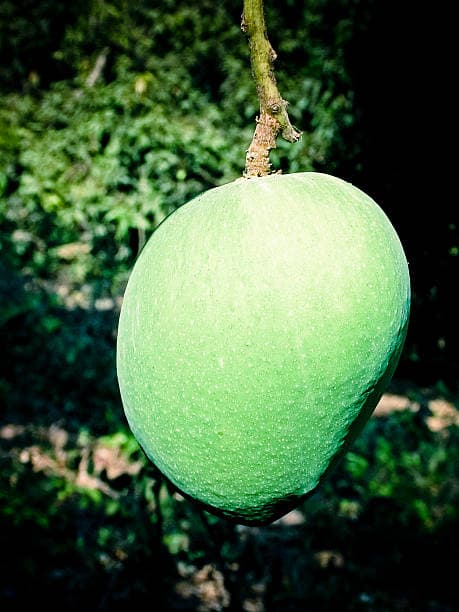
It breaks every rule in the mango book. While every other variety signals ripeness by turning yellow or golden, the Langra stays stubbornly, beautifully green. This 250-year-old heritage variety from the ghats of Varanasi has confused and delighted mango lovers for centuries with its visual deception and extraordinary taste. Beneath that green skin lies one of the most complex flavour profiles in the Indian mango world — a sweet-tangy balance with fresh citrus undertones that is deeply, irresistibly addictive. This is the complete guide to India's most underestimated mango.
01
1. The 250-Year Origin in Varanasi
The Langra mango is believed to have originated approximately 250 years ago in Varanasi (Banaras), one of India's oldest continuously inhabited cities. Legend holds that the original tree grew in the backyard of a man with a physical disability — 'Langra' translates to 'lame' in Hindi — and the variety was named after him. Despite the controversial etymology, the name has persisted for centuries. Today, the Langra is grown extensively across Uttar Pradesh, Bihar, West Bengal, and Jharkhand.
Acquire the Harvest
Direct from our Konkan Orchards
Naturally ripened with hay. GI-Certified. Zero carbide. Delivered in 48 hours.
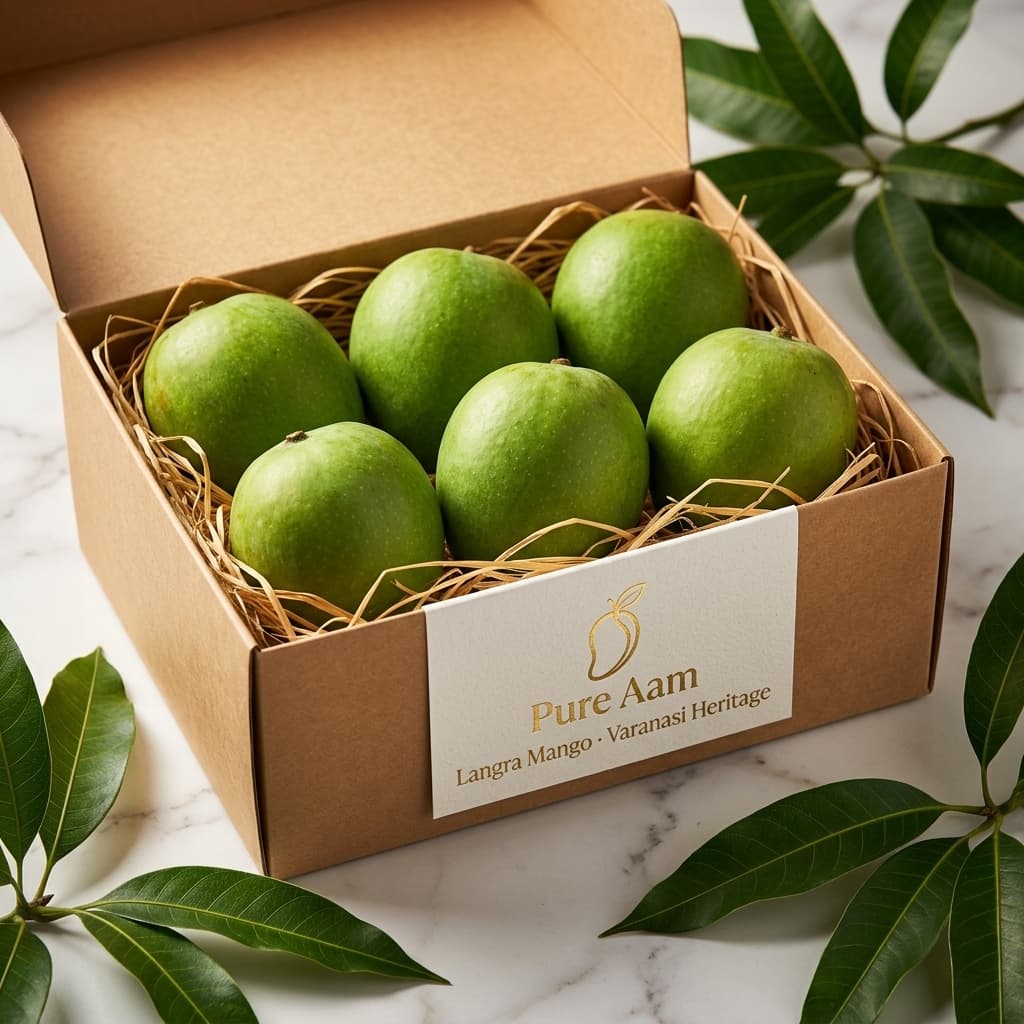 Farm Fresh
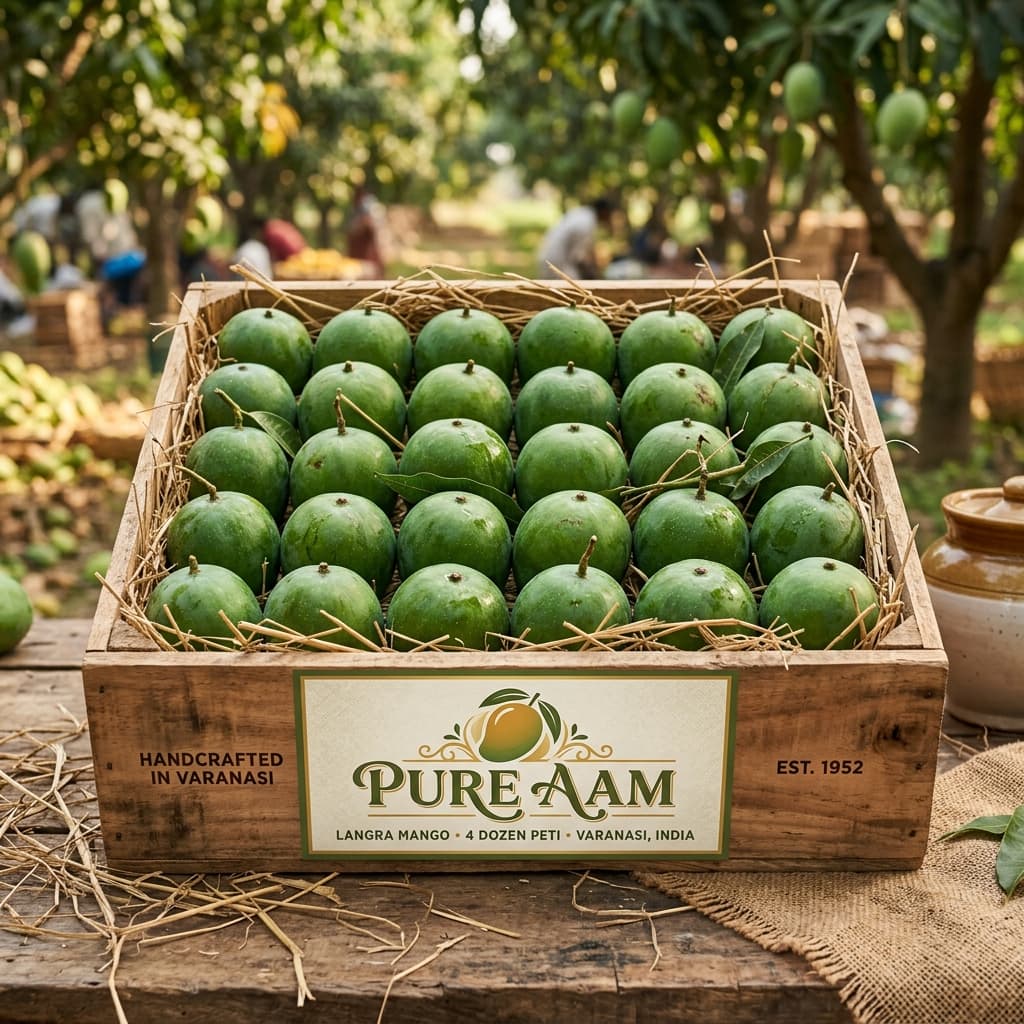 Bulk Value
02
2. The Green Skin Mystery: Why It Never Turns Yellow
The Langra's most famous characteristic is that it remains green even when perfectly ripe. While other mangoes degrade chlorophyll during ripening (revealing yellow carotenoid pigments underneath), the Langra retains its chlorophyll due to a genetic trait that keeps the chloroplasts active throughout maturation. The sugars, aromas, and textures develop fully underneath, but the visual signal of ripeness never appears. This is why first-time Langra buyers often wait too long — expecting yellow — and the fruit over-ripens.
03
3. The Sweet-Tangy Flavour Masterpiece
The Langra offers what may be the most complex flavour profile of any Indian mango. It begins with a rush of sweetness, followed by a wave of mild tanginess, and finishes with fresh citrus-floral undertones. This layered experience is the result of a uniquely balanced sugar-to-acid ratio. Unlike the Dasheri which is pure nectar-sweetness, or the Chausa which is overwhelmingly honeyed, the Langra creates a dynamic palate experience that changes with every bite. Many connoisseurs consider this complexity superior to single-note sweetness.
04
4. Brix Levels: 18–22° — The Premium Tier
The Langra tests at 18–22° Brix — firmly in the premium mango tier and comparable to the Alphonso. However, the Langra's perceived sweetness is modulated by its higher acidity (approximately 0.5–0.7%), which creates the characteristic tangy counterpoint. This acid-sugar interplay is what gives the Langra its refreshing quality — you can eat several Langra mangoes in succession without feeling overwhelmed, which is harder to do with a ultra-sweet variety like Chausa.
05
5. Physical Characteristics
The Langra is a medium-to-large mango, weighing 250–400g — one of the heftier premium varieties. It has a rounded, slightly ovoid shape with a gentle curve. The skin is always green — ranging from bright green to dull olive-green when ripe — and may develop subtle golden undertones near the stem at peak maturity. The flesh is a vibrant deep yellow-orange, creamy, smooth, and completely fiberless. The seed is medium-sized with an excellent pulp-to-seed ratio.
06
6. Season: June to August
The Langra is a mid-to-late season variety, with the harvest running from June through August. This timing positions it perfectly after the Alphonso and Dasheri peaks, providing premium mango availability during the monsoon months. The Langra's slightly later season is a geographical consequence — the eastern UP and Bihar orchards receive the summer heat waves later than the western states. At PureAam, we dispatch Langra from mid-June through July.
07
7. How to Tell When Langra Is Ripe
Since colour cannot guide you, use these three methods: (1) The Pressure Test — a ripe Langra yields gently to thumb pressure, similar to pressing a ripe avocado. If it is hard, wait 1–2 days. (2) The Stem Aroma Test — bring the stem end close to your nose. A ripe Langra produces a strong, sweet, tropical aroma from the stem area. No aroma means not ripe. (3) The Weight Test — a ripe Langra feels heavier than it looks due to sugar and juice accumulation. We deliver Langra at Day 2–3 of ripeness, ready to eat within 24 hours.
08
8. Culinary Uses: The All-Rounder
The Langra's balanced sweet-tangy profile makes it arguably the most versatile premium mango in the kitchen. It makes outstanding aamras (the tanginess prevents the dish from being cloyingly sweet). It is the preferred mango for traditional 'aam ka panna' — the summer cooler — due to its natural acidity. Sliced Langra with chaat masala is a street-food classic of Varanasi. And its high juice content makes it the best variety for fresh mango juice.
09
9. The Cultural Significance in Banaras
In Varanasi, the Langra is more than a fruit — it is a cultural identity. The arrival of the Langra season is celebrated in traditional households with the same reverence as a festival. Families have generational preferences for specific orchards. The Langra is the default offering at religious ceremonies during June–July. And the evening ritual of eating chilled Langra on the ghats while watching the Ganga aarti is one of Varanasi's most beloved summer traditions.
010
10. Ordering Authentic Langra
When ordering Langra, always confirm: (1) green skin is normal and expected; (2) the source should be eastern UP, Bihar, or West Bengal; (3) natural ripening is non-negotiable — carbide-treated Langra loses its signature tanginess. At PureAam, our Langra Premium Box contains 12 heritage-orchard fruits from Varanasi, and our 4 Dozen Peti contains 48 fruits for families. Both are naturally ripened and dispatched within 24 hours.
SP
Expert Reviewer
Suresh Patil
Suresh is a 3rd generation Alphonso specialist with 25+ years in the orchards of Ratnagiri. He leads our harvest quality control and traditional hay-ripening protocols to ensure every box meets the Pure Aam standard.